






Building Cyber Resilience Through NIS2 Compliance

Building Cyber Resilience Through NIS2 Compliance
For many organisations, the Network and Information Systems Directive 2 (NIS2) begins with a compliance question: does it apply to us, what must we demonstrate and which measures need to be in place?
These questions matter. But the organisations that gain the greatest value from NIS2 are often not those focused only on compliance. They are the ones using it as an opportunity to understand a bigger issue: whether their organisation can continue operating effectively when technology, suppliers or cyber incidents disrupt the status quo.
NIS2 connects cybersecurity risk management with leadership accountability, incident response, business continuity and supply-chain security. Its wider value? This lies in helping you strengthen how these capabilities work together. The opportunity is not simply to demonstrate compliance. It is to use NIS2 as a catalyst for building wider cyber resilience.
In this article, we explore 4 questions:
- Why is NIS2 more than a compliance project?
- What does it change for senior leaders?
- Why must compliance connect with operational resilience?
- How are supplier dependencies and artificial intelligence changing the risk picture?
1. Why NIS2 is more than a compliance project
Cyber risk rarely follows the boundaries of one policy, technology or business function. An incident originating through a supplier could affect cloud services, compromise data and interrupt critical operations. Your IT and security teams may need to investigate the threat while business leaders make decisions about containment, continuity, communications and regulatory reporting, often before the complete picture is known.
NIS2 reflects this interconnected reality. Its requirements span cyber risk management, incident handling and reporting, business continuity, recovery, supply-chain security and management oversight. Meeting them depends on more than assigning separate actions to different teams, but this is often easier said than done.
Where organisations find NIS2 compliance most difficult
- 50% Vulnerability and spatch management
- 49% Business continuity and disaster recovery
- 37% Supply-chain risk management
Source: ENISA, NIS Investments 2025. The study gathered responses from 1,080 professionals representing organisations across all 27 EU Member States and sectors of high criticality covered by NIS2.
These are not technology problems. They are operational, governance and leadership challenges. Addressing them requires security, business continuity, procurement, risk and leadership teams to work from a shared understanding of what your organisation depends on and how disruption would be managed.
If you have a lean internal team, disconnected compliance activity can place further pressure on already stretched specialists. If you operate across multiple business units, technologies, suppliers or jurisdictions, coordinating ownership may be the greater challenge.

NIS2 creates even more value when you use it to connect cyber governance with the wider decisions that shape resilience, from technology and supplier choices to incident response and business continuity.''
For smaller and medium-sized organisations, some of the greatest practical challenges may be maintaining the specialist capacity needed for continuous detection, investigation and incident response. These capabilities require appropriate technology, processes and expertise, as well as the ability to act quickly when a potential incident is identified.
Organisations should therefore assess which capabilities they can maintain effectively in-house and where external expertise may be needed. Managed support can strengthen specific aspects of NIS2 readiness, but it does not transfer accountability or address every requirement of the directive. In either case, compliance activity will deliver limited value if it does not strengthen how your organisation anticipates, manages and recovers from cyber disruption.
Where managed security support can help
Ricoh’s Global Security Operations Centre supports organisations with managed detection and response, continuous security monitoring, investigation and incident escalation. These capabilities can strengthen specific elements of operational readiness as part of a broader organisational approach to NIS2.2
2. What does NIS2 mean for senior leaders?
NIS2 acknowledges a reality many organisations have already discovered: cyber resilience is ultimately a leadership issue. The directive makes this explicit by requiring management bodies not only to approve cybersecurity risk-management measures, but to oversee their effectiveness and develop the knowledge needed to challenge, guide and govern cybersecurity decisions. But greater accountability does not mean directors and executives must become security specialists or intervene in every operational decision. Their responsibility is to ensure that your organisation has the governance, resources and decision-making structures needed to manage cyber risk effectively.
That requires more than receiving periodic reports about vulnerabilities, incidents or compliance activity. Leaders need enough business context to understand which services are most critical, where material dependencies exist and whether identified risks are being addressed. They also need confidence that the right people have the authority to make time-sensitive decisions when an incident occurs.
Technical activity and organisational readiness are not the same thing
"Your security specialists may operate controls, monitor threats and provide expert advice. But leadership determines which risks the organisation prioritises, where it invests and how much disruption it is prepared to tolerate."
"Effective oversight therefore depends on expressing cyber risk in terms leaders can act on: operational disruption, financial exposure, regulatory obligations, customer impact and reputation."
NIS2 in Practice: Leadership Accountability Matters
NIS2 makes cybersecurity a leadership responsibility, not just an IT issue. For organisations in scope, management bodies are expected to oversee cybersecurity risk-management measures, understand material risks and ensure appropriate governance is in place. Leaders need visibility into critical dependencies, major risks, supplier exposures and incident readiness to make informed decisions.
Want more practical guidance?
Download The Cybersecurity Readiness Gap report to explore how leading organisations are establishing governance, assigning accountability, testing response plans and strengthening cyber readiness in practice.

3. How can organisations prepare for NIS2 incident reporting?
The effectiveness of cyber governance becomes clearest during an incident. Technical investigation, operational decisions, regulatory assessment and stakeholder communication may all need to happen at the same time. Your teams may also have incomplete information and limited time in which to act. A documented incident-response plan is important, but documentation alone does not establish readiness.
Plans can break down when decision-making authority is unclear, business priorities have not been agreed or technical and business teams have different understandings of what must happen first. Supplier and cloud dependencies can further complicate the response. Responsibilities, escalation routes and access to information need to be understood before disruption occurs.
NIS2 reporting requirements add urgency because your organisation may need to assess and escalate a significant incident before its full impact is known.
For significant incidents, organisations must report within these deadlines:
- Within 24 hours of awareness: Early warning
- Within 72 hours of awareness: Incident notification
- Within one month of the notification: Final report
- If the incident is still ongoing: Progress report, followed by a final report within one month of the incident being handled
Meeting these timelines depends on more than knowing the deadlines. Organisations need clear reporting thresholds, escalation routes, decision-making authority and access to the information required to assess an incident quickly --including arrangements for incidents identified outside normal working hours.
Threat identified
Potential business impact assessed
Decision-makers informed
Appropriate action authorised
Response coordinated
Lessons applied
Regulatory requirements can clarify the measures and evidence your organisation may need. Resilience depends on whether your people can use those measures to recognise a material threat, make decisions and coordinate action under pressure.
4. How does NIS2 affect supplier and AI risk?
Cyber resilience is not fixed when you approve a policy or complete a compliance programme. New technologies, suppliers and ways of working continually change what your organisation depends on, and where disruption could originate.
Cloud platforms, managed services and technology partners can give you access to capabilities that would be difficult or inefficient to maintain internally. But they also extend critical operations beyond your direct control.
65% of large companies identify third-party and supply-chain vulnerabilities as their greatest barrier to cyber resilience
27% of surveyed organisations simulate supply-chain cyber incidents or conduct recovery exercises
The gap between concern and preparation shows why supplier governance cannot end with due diligence at the beginning of a contract.
You need an ongoing understanding of which providers support critical services, how incidents will be communicated and where responsibility lies if those services are disrupted.
Artificial intelligence (AI) creates a related governance challenge. AI-enabled capabilities may enter your environment through new tools or through features added to services you already use. This can create new data flows, access paths and automated decisions before ownership, acceptable use, logging and human oversight are fully established. AI is not a separate NIS2 requirement. However, its rapid adoption demonstrates why your risk-management and governance capabilities must be able to respond to change.
A control environment assessed at one point may no longer reflect how your organisation uses technology, data or suppliers several months later. Compliance cannot therefore be treated as a finished state. Cyber resilience depends on maintaining visibility as dependencies change and ensuring that governance keeps pace with your organisation.
Turn NIS2 compliance into sustained cyber readiness
NIS2 gives you an important regulatory reason to strengthen cybersecurity. Its long-term value depends on whether that work improves your ability to manage risk and maintain critical operations.
- SECURE: Understand exposure, strengthen protection and ensure existing controls operate as intended.
- RESILIENT: Connect visibility, detection, response and recovery so you can limit disruption.
- READY: Enable people, governance and decision-making to adapt as risks and dependencies evolve.
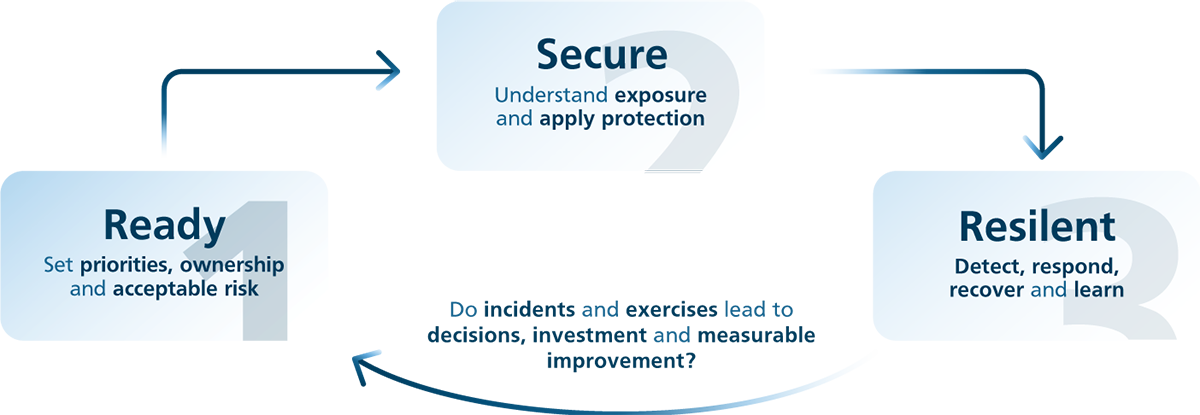
The value of this framework lies in the connections between the three.
Governance must lead to stronger controls. Monitoring and response teams need enough visibility and business context to recognise material threats. Lessons from incidents and exercises should influence future priorities, responsibilities and investment. This creates a continuous cycle in which risk informs protection, security events drive coordinated action and experience leads to improvement.
It also gives your leaders a clearer basis for understanding whether NIS2 activity is strengthening the organisation in practice, or producing another disconnected layer of compliance. Cyber resilience does not mean predicting every threat or eliminating every vulnerability. It means building the organisational capability to protect what matters, respond as circumstances change and make confident decisions under pressure.
Local expertise, connected across EMEA
brings together specialist Cloud & Cybersecurity expertise across EMEA, combining local customer support with capabilities spanning cybersecurity, cloud, infrastructure and other critical technology environments.
This helps organisations identify security blind spots, strengthen protection across connected environments and access the support they need locally and across EMEA.





Let’s connect
Talk to a Ricoh expert
Transform your workplace with Ricoh’s Business solutions.
Boost efficiency, reduce costs, and accelerate your journey towards digital transformation.
- The application of NIS2 depends on your organisation’s sector, size, jurisdiction and relevant national implementing legislation. This article provides general information and does not constitute legal or regulatory advice.
- These capabilities can strengthen specific elements of operational readiness relevant to NIS2 as part of a broader organisational approach. They do not cover every requirement of the directive or constitute NIS2 compliance in themselves.